
What a sale actually costs you, from checkout to payout
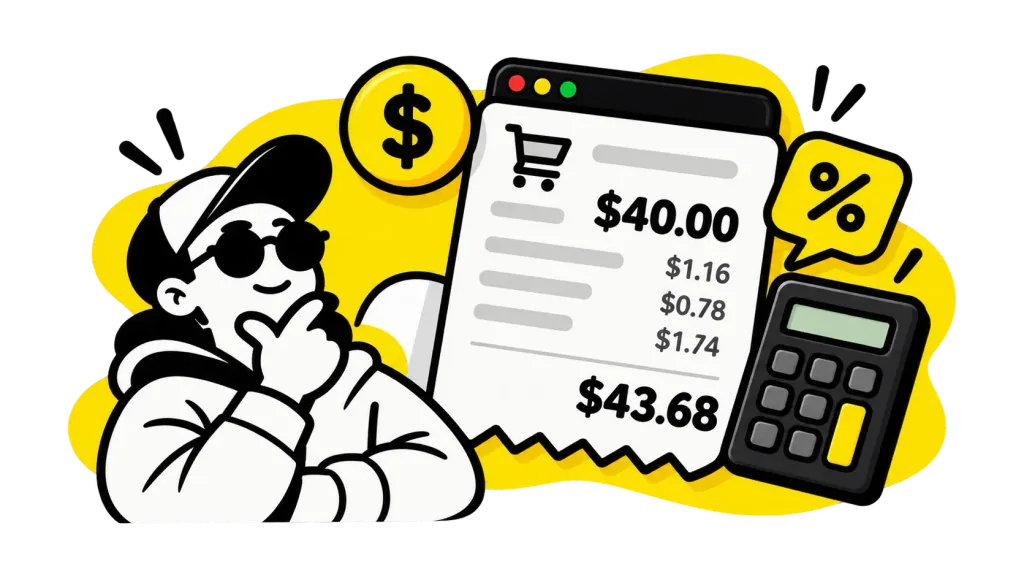
A $40 order with a 2.9% processor costs 4.35% of the product price, because the fee is charged on the shipping and the tax as well. Here is the full chain, in order, and the price that survives it.
Ama Mundum LLC Team5 min read
Your processor advertises 2.9% plus 30 cents. On a $40 product sold with $6 shipping and 8% tax, you pay $1.74, which is 4.35% of the price you actually sold at.
Nothing went wrong. The percentage was applied to the right number. It just was not the number you were thinking of.
The fee is charged on money that is not yours
Most processors calculate their percentage on the total amount charged to the customer, not on your product price. Shipping is in that total. Collected tax is in that total. Both are money that leaves again, and you pay a processing fee on them on the way through.
So the $40 sale is really a $49.68 transaction:
| Product | $40.00 |
| Shipping charged | $6.00 |
| Tax at 8% | $3.68 |
| Customer pays | $49.68 |
And 2.9% + $0.30 of $49.68 is $1.74, not the $1.46 you would get from the product price alone.
This varies by provider and by country, so do not take it from us: open one real payout line and check which number the percentage was applied to. If it was the gross charge, every fee estimate you have made from the product price is low.
Where the rest of it goes
The deductions do not all come from the same place, and that is what makes the arithmetic slippery. Following the same order:
| Step | Amount | Left |
|---|---|---|
| Customer pays | $49.68 | $49.68 |
| Processing fee, 2.9% + $0.30 | −$1.74 | $47.94 |
| Tax remitted to the state | −$3.68 | $44.26 |
| Shipping label, actual cost | −$6.50 | $37.76 |
| Product cost | −$22.00 | $15.76 |
A $15.76 gross profit on a $40 product is a 39.4% margin, and that is before you have paid for anything that is not this order.
Two things in that table are worth sitting with. The shipping you charged was $6.00 and the label cost $6.50, so delivery lost money quietly while looking like a line that paid for itself. And the tax, which was never yours, cost you 11 cents in processing fees on its way through your account.
Why you cannot just add the percentages up
If you sell through a marketplace or pay an affiliate, there is usually a commission as well, and it is also a percentage of the gross. Those two do add: a 10% commission and a 2.9% fee, both charged on the same $49.68, come to 12.9% of it.
What does not add is your margin. Margin is measured against the selling price, and the fee is charged on the selling price, so both of them depend on the answer you are trying to find. You cannot take your cost, add 40%, and expect a 40% margin. You have to solve for the price:
Price = Total cost ÷ (1 − Margin% − Fee%)
That is what the selling price calculatorOpen tool does. $22 of cost at a 40% target with a 3% fee gives $39.05, not $30.80.
The fixed fee has a hiding place
Our selling price calculator takes a percentage fee and no fixed fee, which looks like a gap. It is not, quite: the algebra puts the fixed fee in the Additional costs field, and the result is exact rather than approximate.
A flat 30 cents comes off every sale no matter what the price is, which is the definition of a per-unit cost. Add it there and the formula solves correctly:
| $22 product, 40% target | Price | Margin you actually get |
|---|---|---|
| Fixed fee left out | $38.53 | 39.2% |
| 30 cents in Additional costs | $39.05 | 40.0% |
Half a point. Easy to ignore. Now the same omission on a cheap item:
| $4 product, 40% target | Price | Margin you actually get |
|---|---|---|
| Fixed fee left out | $7.01 | 35.7% |
| 30 cents in Additional costs | $7.53 | 40.0% |
Over four points, because a fixed fee is a bigger share of a small price. The cheaper your catalogue, the more that one field matters.
Refunds cost more than the sale earned
When an order comes back, the goods return and the fee usually does not. Many processors keep the fixed portion, and several keep the percentage too. On the order above, a full refund returns $49.68 to the customer, and you are out the $1.74 you already paid plus whatever the return shipping costs.
That is why a 5% refund rate is not a 5% problem. Run your own numbers through the payment fee calculatorOpen tool twice, once for the sale and once for the refund, and the gap is the real cost of a return.
What to do with this
- Find out what base your processor uses. One payout line answers it.
- Estimate fees from the charge total, shipping and tax included, not the product price.
- Put the fixed fee in Additional costs when you solve for a price.
- Price the shipping you actually pay, not the shipping you hope to pay. The free shipping calculatorOpen tool shows what absorbing it does to the margin.
- Check the small end of your catalogue first. Every effect on this page gets worse as the price gets lower.
The headline rate on your processor's pricing page is accurate. It is just not the rate you pay.