How to run a Secret Santa name draw fairly
A simple way to draw names for a Secret Santa without duplicate picks, visible slips or a spreadsheet that gives away the answer.
Ama Mundum LLC Team4 min read
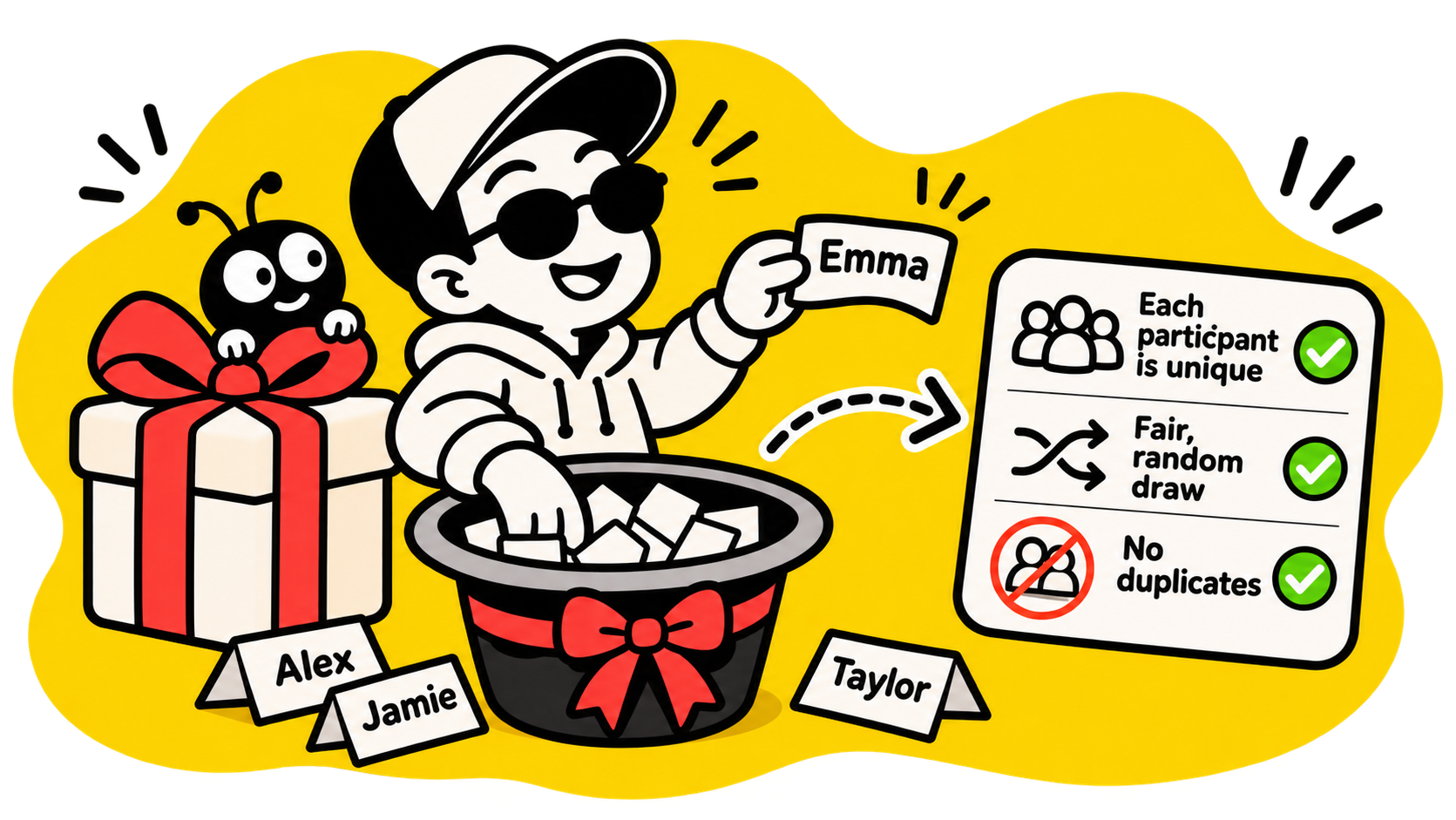
The difficult part of a Secret Santa draw is not choosing a name. It is keeping the draw fair while making sure nobody sees the whole list.
Writing names on paper works for a small group, but it creates two problems: a person can draw their own name, and the last person may be left with an impossible result. A spreadsheet has the same problem in a different costume: whoever owns it can see every match.
Start with the rules
Before drawing, agree on four things:
- who is participating;
- the spending limit;
- the date for exchanging gifts;
- whether people can opt out of certain gifts or categories.
The list should contain one entry per participant. If “Sam” appears twice because two people share the name, add a distinguishing detail such as “Sam — design” and “Sam — sales”.
Clean the list before you draw
Names copied from a group chat often contain blank lines, extra spaces or a second copy of someone’s name. Those are not harmless formatting issues: they change the odds.
Paste one participant per line and check the list visually. For a small group, count the names aloud. A group of 12 people should produce 12 entries, not 13 because a blank line was pasted at the end.
The Random Name PickerOpen tool treats each line as an item and picks one at a time. Remove the selected name before the next pick so every entry can be chosen once.
The fair manual process
If you are running the draw in front of the group:
- Paste the complete list.
- Pick one name.
- Record the recipient privately.
- Remove that name from the working list.
- Repeat until everyone has a recipient.
The person running the draw will necessarily know the assignments. If that is not acceptable, use separate private messages or let each participant run a draw with a list that excludes themselves and includes agreed constraints.
Randomness can choose a name. It cannot enforce a complicated set of social rules after the draw has started.
What if someone draws themselves?
For a casual exchange, the simplest answer is to redraw the final two names if the last person would receive themselves. Do not keep redrawing the entire group: that makes the process harder to explain and changes more assignments than necessary.
For a larger group, use a circle: randomize the participant order, then each person gives to the next person in the circle. Nobody gets themselves, every person gives once and every person receives once.
That method is predictable to the organizer but still fair if the order is randomized first.
Keep the result private
The tool runs in your browser, but privacy also depends on what you do with the result. Do not project the complete assignment list or paste it into the group chat. Send each person only their own recipient, and double-check the message before sending it.
If a participant drops out, redraw the affected assignments instead of trying to patch the old list from memory. A small record of the original list and the change will save confusion later.
The useful checklist
- One line per participant.
- Shared names made unambiguous.
- Budget and date agreed before the draw.
- Selected names removed after each pick.
- Final assignments sent privately.
- Changes recorded if someone leaves.
The draw is the easy part. A clean list and a private handoff are what keep a five-minute game from turning into a group-chat investigation.